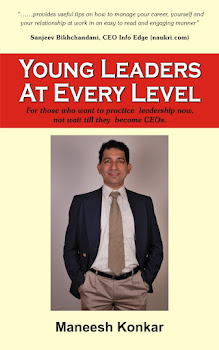
Are you a young leader in your company? In a role where you need to give direction?

Steve Jobs said "your work is going to occupy a large part of your life and the only way to be truly satisfied is to do great quality work. And the only way to do great quality work is to enjoy what you do".


And click on links below to BUY THE BOOK NOW!!

Young Leaders at Every Level - Buy the ebook now for $7.99. Immediate Download.

Young Leaders at Every Level - Buy the ebook now for $7.99. Immediate Download.
The story of a young MBA Abhijit Joshi climbing the organizational ladder. Follow him as he discover's his passion, figures out the money equation and takes charge of his life and work. Eventually reaching the pinnacle of success winning the CEO of the Year award. Buy the eBook NOW for $5.99. Immediate download & Happy Reading..

August 17, 2012

Outstanding Leadership Quotes


Check out these outstanding quotes from a just concluded Leadership Summit


Quotes and concepts from speakers at The Global Leadership Summit:

Craig Groeschel:
  1. If you’re not dead you’re not done.
  2. Don’t fear the new generation, believe in them because they need you.
  3. Delegating tasks creates followers. Delegating authority creates leaders.
  4. Authenticity trumps cool.
  5. Young leaders grossly overestimate what they can do in the short-run and underestimate what can be done in the long-run.
  6. Honor publicly results in influence privately.
  7. Giving people honor helps them become honorable.
  8. Respect is earned. Honor is given.
  9. Create ongoing feedback loops from those who are older andyounger.
  10. Don’t copy what others do. Copy how they think.
  11. How many 16 year olds can write a book? Those who’ve been told they can.

Greed is not Good - especially when the market is down

Gordon Gekko had made this line famous in Wall Street. Greed is good - greed for knowledge, for life, for love, Greed has marked the upward surge of mankind.................................

Has it?

Have today's greedy sales people really marked the upward surge of their industries? Lets ask our friends in the insurance industry, where their greed has got them. The last time I checked, the largest company had shed 40% of its staff in eighteen months.

When market is down, when sales are not happening, when bosses send you ten messages a day, when everything is urgent and required yesterday, what does one do? How does one handle all this killing pressure from the "system?"

Get back to the basics, we would say.

What is selling? 
Certainly not dumping your products on an unsuspecting buyer.
Not spray and pray, not making the same pitch to every buyer.
Not the buffet counter method of selling, where the entire product range is shown to the customer, who gets so confused that he does not place a single order.

Instead, if we just followed the basics of selling, we would not have to struggle so much.

Selling is just about creating demand.

What is creating demand for our products?

It consists of two steps:
a. Researching our customer's business to identify areas for improvement - "pain areas".
b. Positioning our products as a means of reducing that pain.

A salesperson in the building construction industry trying to sell tiles to a builder. Builder wants the lowest price. Seller identifies builder's poor sales as a "pain area". positions the tiles as a sales tool to help the builder justify the high price he is charging

Seller of premium roofing solutions is getting price resistance from warehouse owners. Seller studies high cost of electricity as a "pain area". Presents a scientific calculation of how his products would save money in the long run.

.............................examples and concept mentioned in detail in the book "Young Leaders at Every Level" where Abhijit handles these challenges as a Sales Manager. Click on link to buy eBook now. Immediate download. 

July 16, 2012

Think Twice Before Promoting Your Best Salesperson


Of course, many great salespeople can and do become great managers. But this is not always the case. Too often, when a super-salesperson gets promoted to manager, one or more of the following happens:


  • He (or she) can't let go of his old role. He takes charge of customer relationships and jumps in to close deals, undermining salespeople's motivation and confidence and weakening their relationships with customers.

  • He manages by results only. He expects everyone to produce the same results that he got as a salesperson, but isn't good at coaching and giving people constructive feedback on how to get there.

  • He avoids administrative responsibilities. He becomes frustrated by the many routine but important tasks that headquarters requires of him.

Before long, the salespeople he manages stop learning and growing. They become disenchanted, disengage from their work, and may even leave the company. Soon, district performance is in jeopardy.
What it takes to succeed in sales is different from what it takes to succeed in management.Salespeople succeed when they meet customer needs while achieving the company's financial goals for their territories. Sales managers also succeed by meeting customer needs and achieving objectives linked to company goals. But the manager is not the hunter, the playmaker, or the center of action. Managers contribute to customer and company success when their team of people is successful.
Managers are coaches, not players; they get satisfaction from achieving objectives through others. When a salesperson gets promoted to manager, it's no longer about "me" — it's about "the team." Managers help people grow by walking around with a watering can in one hand and a bag of fertilizer in the other.
Unless you select salespeople who have the characteristics it takes to do the next job well (not just those who have demonstrated success in their current job), your sales management team will be average at best.
What can you do to ensure that the right people get selected for the sales manager job?

Medical device company Boston Scientific has a formalized corporate program for selecting and developing internal candidates for sales manager positions. According to Chris Hartman, Vice President, Central Zone, for Boston Scientific's Cardiology, Rhythm and Vascular Group, "We seek candidates from the sales ranks who have demonstrated excellence not only by generating strong sales results, but also who have demonstrated success in teaching others to sell by acting as a mentor to new salespeople, and who have demonstrated success in managing through exposure to leadership opportunities such as a field training role or participation on a sales advisory board or steering committee. Our management assessment and development program tests and trains candidates on competencies such as coaching, performance management, interviewing, and negotiation. The program provides many opportunities for both the candidate and the company to evaluate fit with the sales manager job."
What should you do if an excellent salesperson who lacks managerial characteristics wants to become a manager and threatens to leave if not promoted?
Sometimes, just talking to the individual about what the manager role entails and what it takes to succeed in the job are enough to encourage an unsuitable candidate to withdraw from consideration on her own. If that doesn't work, test her in the role; say by giving her responsibility as a mentor or field trainer, in addition to her sales job. She may discover that the role is not something she enjoys. It's also possible that you'll find out that your initial assessment was wrong. If that's not the case, summon the managerial courage to tell the individual that she is most valuable as an individual contributor. It's better to lose one good salesperson now than it is to risk losing an entire district down the road due to ineffective management.
Cardinal Health uses dual career paths as a way to address the situation. "This enables our sales organization to keep many of the best and brightest salespeople who are most valuable as individual contributors," says Sandy Cantwell, Vice President of Sales Operations. "You can succeed by becoming a manager or by becoming a 'super salesperson.' We have a formal career road map for both management and individual contributor roles. Our top sales role, the Strategic Account Vice President, is roughly equivalent in level to a Regional Vice President on the managerial side."
Select and develop those salespeople who have strong managerial tendencies for sales management positions. At the same time, understand that success as a salesperson alone is not a good predictor of success as a sales manager.

March 30, 2012

Choosing Between Making Money and Doing What You Love

Click on link above to access the article on HBR

"If you're really passionate about what you do, but it's not going to make you a lot of money, should you still do it?"

What a great question! It seems like just about everyone who has ever addressed a graduating class of high school or college seniors has said "Do what you love, the money will follow."

Inspiring. But it is true? Couldn't you do what you truly care about and very well go broke, as the question above (recently sent from one of our readers) implies?

Based on the research we did for our book, we're convinced that when you're heading into the unknown, desire is all-important. You simply want to be doing something that you love, or something that is logically going to lead to something you love, in order to do your best work. That desire will make you more creative and more resourceful, and will help you get further faster.

And, it will help you persist. When you're trying something that's never been attempted before — beginning an unusual project at work, or trying to get a new business off the ground — you're going to face a lot of obstacles. You don't want to be giving up the first time you encounter one.

But, let's be real. None of this guarantees wealth, or even financial success.

A friend of ours was hanging out at a bar with a few fellow professional musicians after a recording session, talking admiringly about another musician they all know. One of them commented on how fortunate it was for this musician that his music was commercial. In those four words, you will find an enormous truth. We all have our music and there is no guarantee that anyone will buy it. Absolutely none. These are two entirely separate things.

So this reader question attacks us straight on and says, in essence, "I have the desire, but I am pretty certain it's not going to lead anywhere that's monetarily profitable. Now what? Should I still go ahead?"

Of course you should.

Now let's qualify the answer a bit:

If you can't afford to do the thing you're passionate about — for example, if you do it, you won't be able to feed your family, or it would keep you from graduating college (which is something you think is more important than whatever you're passionate about) — then no, you'd better not bet your economic life on it. A basic principle concerning how you should deal with an unknown future is that every small smart step you take should leave you alive to take the next step. So, make sure you attend to your lower order Maslow needs of food and shelter and the like.

But even this doesn't mean you can't work on your passion a little — even if it's just for 15 minutes a day.

And you should!

Why?

Research (such as The Power of Small Wins that ran in Harvard Business Review May, 2011) shows that people who make progress every day toward something they care about report being satisfied and fulfilled.

We're in favor of people being happy. And we're also in favor of provoking people into pursuing happiness. The nice thing about this reader's question is that it might get people who have — by any objective standard — more than enough money to reconsider whether they want to continue to do things that are not making them happy, just because it'll make them more money. More often than not, these people say, "Once I get enough money, I'll do what I really want to do. I won't worry about the money." But somehow, they never get to that point. Time is finite. The question might be enough to get you to reconsider how you're spending it.

And of course, the assumption embedded in the question could be wrong. You might, indeed, end up making money if you engage in your passion, even though you currently think you won't. Remember, the future is unknown. Who knows what people will buy, or what you might invent after your very next act. At any moment in time, you are only one thought away from an insight — an insight that can change everything.

As we said in our previous post, when you are facing the unknown, they only way to know anything for sure is to act. When you are dealing with uncertainty — and whether you are going to make any money from your passion at this point is definitely an uncertainty — you act. You don't think about what might happen, or try to predict the outcome, or plan for every contingency. You take a small step toward making it a reality, and you see what happens.

Who knows? Even the smallest step can change everything.

So take those small steps. You might discover that your passion does, in fact, make you money. After all, who knew you could make huge amounts of money figuring out a way to connect all your friends (Facebook) or make a better map (pick your favorite GPS tool).

Even if you don't, you want to spend part of your day doing at least one thing that's making you happy. Otherwise, something is terribly wrong.

Leonard A. Schlesinger, Charles F. Kiefer, and Paul B. Brown

LEONARD A. SCHLESINGER, CHARLES F. KIEFER, AND PAUL B. BROWN

Leonard A. Schlesinger is the president of Babson College. Charles F. Kiefer is president of Innovation Associates. Paul B. Brown is a long-time contributor to the New York Times. They are the coauthors of Just Start: Take Action, Embrace Uncertainty, Create the Future(HBR Press 2012). Learn more at juststartthebook.com.


February 9, 2012

Don't Confuse Passion with Competence

Click on link above to access original article from HBR blog


The most successful innovators are consistently portrayed as possessing a passion that borders on dogmatism. They work tirelessly to bend reality to achieve their vision, with Steve Jobs and his "reality distortion field" serving as the prototypical example.

There's no doubt that passion is a critical component of innovation. After all, innovation is awfully hard work, with plenty of false starts. Rosabeth Moss Kanter teaches thateverything can look like a failure in the middle. Mike Tyson puts it another way: "Everybody has a plan, until they get punched in the face." Passion is necessary to keep pushing when the punch inevitably lands.

And without passion it's hard to do something that's meaningfully different from what has been done before. It's next to impossible to prove that a new idea will work. Passion and intuition are necessary ingredients for disruptive success.

But leaders overseeing innovation efforts inside their companies need to be careful of mistaking passion for competence. The philosopher George Santayana defined a fanatic as someone redoubles their effort when they have forgotten their aim. We've all encountered the innovator who keeps pounding the table, insisting that his vision is right despite mounting evidence (and bills) suggesting otherwise.

Passion only matters if it leads to an innovation that delivers impact, whether that impact is measured in revenues, profits, improved process performance, or something entirely differently. This is one reason why good venture capital investors dole out capital in stages. They are waiting to see if the vision that looks so great on paper bears any resemblance to reality.

When I'm evaluating entrepreneurs and their ideas, I look for "innovation bipolarity," a version of F. Scott Fitzgerald's first-rate intelligence: "the ability to hold two opposed ideas in the mind at the same time and still retain the ability to function." Entrepreneurs should be able to argue passionately that their idea will change the world, and then, without skipping a beat, honestly assess the risks standing in the way of its success and describe what they are doing to mitigate them.

Of course, there are examples of dogmatism and fanaticism triumphing in the face of healthy skepticism. But that's not a scalable approach to innovation.

Scott Anthony

SCOTT ANTHONY

Scott leads Innosight’s Asian operations. His fourth book on innovation, The Little Black Book of Innovation, will be released in early 2012. Follow him on Twitter at@ScottDAnthony.


January 31, 2012

P&G To Lay Off 1,600 After Discovering It's Free To Advertise On Facebook

Click on link above to read full article on Business Insider

Reality appears to have finally arrived at Procter & Gamble, the world's largest marketer, whose $10 billion annual ad budget has hurt the company's margins.

P&G said it would lay off 1,600 staffers, including marketers, as part of a cost-cutting exercise. More interestingly, CEO Robert McDonald finally seems to have woken up to the fact that he cannot keep increasing P&G's ad budget forever, regardless of what happens to its sales.

He told Wall Street analysts that he would have to "moderate" his ad budget because Facebook and Google can be "more efficient" than the traditional media that usually eats the lion's share of P&G's ad budget.

This is coming from the man who increased P&G's adspend by a staggering 24 percent over the two years through October 2011, even though sales rose only 6 percent in the same period.

Note that P&G's revenues were up 4 percent to $22 billion in the quarter but the company's costs for sales, general and administrative work were flat.

P&G's staggering ad budget has become a bit of an issue among analysts. On the call, McDonald and his crew were asked about ad costs three different times. McDonald eventually said:

As we've said historically, the 9% to 11% range [for advertising as a percentage of sales] has been what we have spent. Actually, I believe that over time, we will see the increase in the cost of advertising moderate. There are just so many different media available today and we're quickly moving more and more of our businesses into digital. And in that space, there are lots of different avenues available.

In the digital space, with things like Facebook and Google and others, we find that the return on investment of the advertising, when properly designed, when the big idea is there, can be much more efficient. One example is our Old Spice campaign, where we had 1.8 billion free impressions and there are many other examples I can cite from all over the world. So while there may be pressure on advertising, particularly in the United States, for example, during the year of a presidential election, there are mitigating factors like the plethora of media available.

P&G's Old Spice campaign is a textbook example of what the entire company should be doing. The problem is that the entire company isn't doing it. Check out Mr. Clean's Twitter stream, for instance. Oh, right—he doesn't have one.

McDonald's recent discovery that digital media is free comes after the long-delayed launch of Tide Pods, now scheduled for a month from now but with only a limited supply. It was originally planned for July 2011. The ad budget for that campaign is estimated at $150 million and will come from agency Saatchi & Saatchi.

The problem is that while P&G has struggled to get a single U.S. pod out the factory door, several of its competitors have already launched competing laundry pod products.


Jim Edwards


January 30, 2012

7 Money Mistakes Entrepreneurs make

Click on link above to read the article on Entrepreneur.com


When Hagan Major, 26, started his online-ad buying business more than a decade ago, he didn't know the first thing about finances.

"We were funneling all of our money into the business and not taking anything out. . . the company was buying us lunch," says Major, co-founder of YellowHammer Media Group in New York. Further, blurring the line between his personal and business finances wasn't just an organizational headache. "It made taxes really complicated," he says. After accidentally using his Social Security number instead of his company's tax ID number to purchase online ads in 2007, Major received a big bill from the Internal Revenue Service: He owed Uncle Sam back-taxes on $60,000 of the company's revenues. "I ended up having to eat the taxes," he says.

Major is hardly the only young business owner to make personal-finance mistakes. "Many successful entrepreneurs become so consumed by the business of the day that some of their personal finance priorities get dropped," says Eric Johnson, a senior client strategist at Signature, a wealth-management firm based in Norfolk, Va.

Related: Tips for Business Owners on Retirement Planning

Here are seven common personal-finance mistakes that young entrepreneurs make – and how to avoid them.

1. Overinvesting in the business
To look more professional, young entrepreneurs may spend their savings too freely. Maybe they lease ritzy offices or purchase high-dollar equipment. Overspending on business expenses that aren't absolutely necessary can quickly erode your personal finances, says Alexa von Tobel, founder and CEO of LearnVest.com, an online personal-finance resource for women. It can be easy to burn through your savings before you even have a product or service to sell, she says. That's when young entrepreneurs dig themselves deeper in the hole personally.

Instead, "spend every dollar you have on building a really good product and get it in front of users," von Tobel says. "If your product isn't good, there's no hope for making any progress."

2. Cutting corners on formalities
All too often, young entrepreneurs will cut corners on legal and accounting advice, notes Johnson. Maybe they know an attorney or a finance guy so they ask if they might help them get licensed or take a look at their books. But those moves can backfire. "Hire someone who is an expert in the specific field that you need," he says.

One accounting mistake, for instance, can lead to paying far more in personal income taxes than you should. And when personal finances are in disarray, it can scare off potential investors and force you to sink even more of your own money into the business.

3. Not paying yourself
Like Major, young business owners tend to live off ramen noodles and plow all of their resources into their business without removing a dime. While this can help keep cash flowing into a business -- not to mention it can be necessary to fund expansion -- it gets tricky when the business is paying your rent and buying you meals. What to do instead? Pay yourself at least a modest salary to keep your personal finances straight -- and separate -- from the business. And don't go overboard by giving yourself a six-figure salary right away. "You need to leave enough money in the business, so it can operate in lean times."

4. Failing to plan for the worst
"Young people often think they're 14 feet tall and bullet proof," Johnson says. But since they're not, they need to plan for the worst. Create a succession plan and some form of insurance to support the business if you can't run it. Johnson recommends setting up a "revocable trust" -- which, unlike a standard will, helps a company bypass the potentially costly court procedure known as "probate" and establish whom should run the business in your stead.

Related: Protecting Your Personal Finances

If you have a partnership and a business that can't easily be sold, Johnson suggests establishing a "buy-sell agreement." This binding agreement governs what happens if a co-owner dies and typically includes an insurance component that provides funding should something happen to either owner.

5. Mixing business and personal assets
Whether it's personally guaranteeing a loan or getting parents to take out a second mortgage on their home, leveraging personal assets for business purposes is a personal-finance no-no. If the business sours, creditors can go after these personal assets. "You should only use the collateral from the business, so, if it goes under, you're not liable personally for the loan," says Lynn Mayabb, senior managing advisor at Kansas City, Mo.'s BKD Wealth Advisors.

6. Using personal credit cards for business purposes
Relying on personal credit cards when a bank won't front your business money can also prove risky. Not only can you be tempted to charge things when you shouldn't, mixing business charges with personal ones can wreak organizational havoc. Just think: What if your business ever gets audited? In that instance, you'll need to provide a record of your business expenses going back at least three years. Instead, apply for a business credit card and use it only on necessary business expenses.

7. Raiding the company’s coffers
If you have two or three months of outsized sales, young people in particular tend to become overconfident, says Mayabb. Being inexperienced, they start spending the business's cash flow indiscriminately. Perhaps they need cars, so they buy the best ones on the lot only to find the next several months at their businesses aren't nearly as successful. "I've seen people drain their businesses this way," says Mayabb.

Diana Ransom is a contributing editor at Entrepreneur.com.