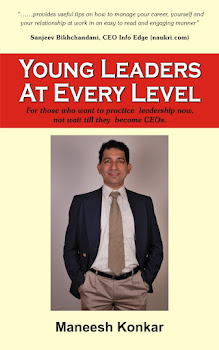
Are you a young leader in your company? In a role where you need to give direction?

Steve Jobs said "your work is going to occupy a large part of your life and the only way to be truly satisfied is to do great quality work. And the only way to do great quality work is to enjoy what you do".


And click on links below to BUY THE BOOK NOW!!

Young Leaders at Every Level - Buy the ebook now for $7.99. Immediate Download.

Young Leaders at Every Level - Buy the ebook now for $7.99. Immediate Download.
The story of a young MBA Abhijit Joshi climbing the organizational ladder. Follow him as he discover's his passion, figures out the money equation and takes charge of his life and work. Eventually reaching the pinnacle of success winning the CEO of the Year award. Buy the eBook NOW for $5.99. Immediate download & Happy Reading..

April 27, 2011

Leadership Lessons from Google

Google's founders Sergey Brin and Larry Page have created a phenomenally successfull company that is the greatest media and internet sensation of our time. Of course they did a lot of things right, below are mentioned some things that stand out:


a. They focussed on creating a superb product: Management schools talk about advertising, these guys had one overriding passion. To create the best search engine in the world. Focus on doing that and they figured the rest would take care of itself. For many months, the Google founders had no clue how their search engine was going to make money, they actually had no clue how to monetize it. These guys were so passionate about creating a better search engine, that was the key. Completely different from the rest of the crowd which creates a mediocre product but then soends tons of money trying to promote it.


b. No advertising: This is one company that has never done any advertising. It initially attracted and continues to attract lakhs and millions of users purely bacause its search engine is the best.


c. Home page - no clutter: Every other website has a highly cluttered home page. That has two dangerous consequences - a - the page takes way too long to load and b - what you actually want you have to search for - which takes time. And time is what a web surfer does not have, The Google home page has no ads. Salute to that


d. A business has to solve real problems: Andy Bechtolschiem, one of the early investors in Google, said "Build something of value and deliver a service compelling enough that people would just use it. That's exactly what Google does - the primary motivation - "an abiding excitement about helping people find more relevant information online, and faster".


e. Have a value proposition that attracts the best employees: And how did they do that. The value proposition to future employees - "millions of people across the world will use and appreciate your software". The investors say about the founders - "they had a great sense of purpose, which is a prerequisite for anybody nutty enough to want to start his own company - says Micheal Moritz of Sequioa Capital. "That burning sense of conviction is what you need to overcome the inevitable obstacles" John Doerr of Kleiner Perkins.


Interested in knowoing more? Read the book. Outstanding work. Google by David Vise. Buy it now.


Superb article for all those who are facing competition from low cost rivals by Professor Nirmalya Kumar from London Business School

Superb article for all those who are facing competition from low cost rivals by Professor Nirmalya Kumar from London Business School. also read the book "Marketing as Strategy" by Harvard Business School press


http://www.facebook.com/l.php?u=http%3A%2F%2Fwww.kdischool.ac.kr%2FUserFiles%2FFile%2F2009%2520Spring%2FMarketing%2520Management%2FStrategies%2520to%2520fight%2520low%2520cost%2520rivals-1.pdf&h=99715

What is the guarantee that my customer will give volumes in the future, if I give him discounts today?

There is no guarantee!!!


We have actually received promises of huge "volumes" of training programs in the future from clients whose bio datas were floating around on job portals. Two weeks later they have put in their resignations and we have felt like fools. By then the discount had already been given


There is a way however. Offer the discount on a staggered basis as and when the volumes actually materialise.

One of our financial services clients gave us this idea. It was a superb example of negotiating with the right amount of maturity and transparency between both parties. Our client was not sure about the volumes he could offer to us. And the relationship was strong. So he suggested a staggered pricing model as follows:


5 units per month - Rs 100 (eg)

6-10 units per month - 10% discount.

10-15 units per month - 25% discount.


Review to be done every six months and the excess payments adjusted through discounts in the next bill.


Brilliant right?


Try it out.


............idea suggested by our very good friend from a financial services company.


How to give discounts without making a complete fool of yourself.

This note is for all the MBAs out there. What are you actually looking for? - a better way to give discounts. Forgotten Kotler - first year MBA. What happens to the brand when we start giving discounts?


And in sales - you are the brand!!!.


Lets discuss a technique to offer discounts which sends the right message to the customer.

Before that, how does the conversation usually happen?


Sales person goes to customer, makes a pitch. Offers a price of Rs 100. Customer responds with Rs 50. Sales person walks out in 5 minutes, comes back into the office and then negotiates for two hours with his bosses.


If only he had the courage to negotiate two hours with the customer!!.


He reverts with a price of Rs. 95. Customer starts laughing. More fun happens. After a few hours or a couple of days, salesman offers a price of Rs 80. Customer issues an ultimatum. Rs 50 by the end of today else I am going with your competitor. The sales guy panics. His boss also panics. The panic travels upwards in the heirarchy till the VP sales also panics. The discoiunt is approved. Customer gets the price of Rs 50. Entire sales team makes their jackpots and super jackpots and incentives.


What is the impression on the customer?


He negotiated a bit. Price dropped from Rs 100 to Rs 95 - dropped by Rs 5.

He negotiated a bit more, price dropped to Rs 80 - this time the drop is Rs 15, it is bigger!!.

He negotiated more, got aggressive - and what happened? The price dropped to Rs 50. This time the drop is Rs 30, the biggest ever!!!


The salesperson has actually given increasing discounts. What message has he inadvertently communicated to the customer?


yes - the tiger has tasted blood.


So what is the right way to do this?


a. Decide a walk - away price: Most sales forces we work with have no concept of this, some do. A walk away price is the absolute lowest price that you will accept, below which you would not be interested in doing business. eg Rs 50 in the above case.


b. Plan on giving "reducing discounts" in stages. Rs 100. Rs 75. Rs 60. Rs 53. Then close at Rs 50. What is the size of each discount? The first discount was Rs 25. The next one was Rs 15, then Rs 7 and the last one was Rs 3.

What is the impression communicated when the discounts go down to Rs 7 and Rs 3?

That no further scope exists to negotiate.


Time to close.


Of course, the best strategy to negotiate is to position yourself in such a manner that the other party does not dare negotiate.

............idea drawn from purchase - vendor negotiations at a large SUV manufacturer based in Mumbai

How can I increase my price and still save costs for my Customers?

Is this actually possible?

Isn't this a zero sum game? If I increase my price, doesn't the customer automatically end up paying more?


Not if you do Solution Selling.


What is Solution selling?


It means suggesting a overall solution for the customer's challenges and problems, not just sending proposals on products and services.


To save costs, it means the following three steps:

a. Understanding the customer's way of looking at cost.

b. Suggesting the best products from our portfolio.

c. And helping the customer save some costs from the total basket of expenses.


Lets see some examples:


a. a paint company studies the entire painting process at their target car companies. This enables them to understand that cost of paint is only a small proportion of total cost for the car company. Additional costs would include cost of downtime, when changing over from one paint to another. This company invented a paint that would clean up faster. The net result - paint shop downtime reduced dramatically. Company benefits by extra production from same assets. Paint company gets a price increase. Win Win for all.


b. A tile company is facing competition from local and unorganized players. It adopts the solutions selling approach. It starts asking the question - does the customer set a budget for the tile? Obviously not. A homeowner has a budget for interiors. I will spend Say Rs 3 Lakhs on my home interiors. A tile owner suggests the better quality Italian designer tiles in his portfolio, simultaneously recommending savings in taps, paint and ceramics. Customer gets a more beautiful house in a lower budget, his overall costs are saved and the tile company achieves a higher sale.


c. An IT Company studies the total cost of business operations and the overall spend of the IT budget. Discovers excess expenses in purchasing the wrong IT infrastructure. Discovers excess expenses in maintenance, obsolescence, spares, etc. Offers a total outsourcing solution by showing business benefits to the senior leadership of the client. Wins the contract which is larger and for a longer duration. Simultaneously saves costs for the client and reduces their pain area.


That's solution selling for you. Sell higher, save costs for the client.


..........based on ideas contributed by senior members of the companies mentioned.


Is there a science to goal setting?

How does goal setting happen in organizations?


Last month you did 100. This month you should do 150. No sir, 150 is too high, I will do 110. Nonsense, 110 is ridiculous, try 135. I will try my best sir, lets keep it 115. OK lets lock it at 125.


Are we setting targets to sell IT systems, soaps, cars, banking products.

Or are we selling fruits and vegetables?


Person who is asking for 150 cannot justify 150, Team member who is asking for 110 has no rationale for 110. Both are clueless.

So what can be the techniques to set goals in a scientific manner:


a. Market growth rate & market share:


You did 100 last quarter. Industry is groing at 10%. Your market share was 16%. To maintain market share you will have to grow 10% in any case. But your target market share is 20%. So the new quarter target is ........


b. Marketing Inputs:


Last month you sold 100. You had no support from marketing. This month, we are giving you the following consumer offers and trade discounts. How much extra do you think you would be in a position to sell?


c. Market Coverage and Fundamentals:


You had a team of ten people last quarter. You are adding three new people and four new distributors to the territory. 550 more outlets will get covered. Each outlet will buy 10 initially then repeat purchase of 4 each week. Therefore new outlet and new market sales would be 300. Your goal for the quarter therefore should be 1350.


any other ways, pl contribute.

...........idea contributed by Aseem Soni, VP Sales of a large fmcg company.

Running a monthly review meeting on inspiration, not fear!!!!

Why are Monthly Review Meetings such a scary affair for all? Salespeople dread the event which happens once in a month. They hide during the meeting, hoping they would not be asked to present their performance. No such luck. fifteen minutes of torture (bamboo), then relief......


And of course, ZERO value add from the Manager in charge of the team. Reaffirms our belief - do we really needs MBAs to ask the question "sales kitna hua?"


We started asking a fundamental question - why should these monthly meetings be a source of fear? Why can't we run them in such a manner where a team member is inspired to attend, where he actually gains from the meeting?


How?


Dr Spencer Johnson says - "Catch people doing something RIGHT".


Most of the time, we do the exact opposite. We keep catching people doing something wrong. We ask them to do ten things, they do nine things right, they goof up on the tenth thing. What gets all the attention? The mistake.


At an fmcg company, we tried a different technique. we celebrated only the winners. We started the meeting by the question "all those who have sold more than hundred petis (boxes) in the month, pl stand up". Two people stood up. Congratulations. Area Manager called them forward, pl share experiences, what did you do? how did you do it? what can we learn from this? etc. No comment for the other 17 sales people.


Next month, same question - "all those who have sold more than 100 boxes pl stand up". This time 6 people stood up. The Regional Manager was there at the meeting heartily congratulating all the six people. No attention paid to the other 13 people who are by now very very uncomfortable.


Another month goes by. Meeting starts with the same question "all those who have sold more than 100 boxes, pl stand up". Every body stands up. Everybody gets a hearty congratulations. Next question "all those who have sold more than 250 boxes, continue standing, rest of you sit down". 9 stay standing, ten sit down. The sales meet continues.


The region - Punjab. Basic people management techniques like these have taken this soap brand to the No 1 position in the state.


The concept works - Catch people doing something right.


.................story contributed by Kishen Kishore, former Regional Manager (North) at a large fmcg company.